Ethiopian Jews and ICEJ
Compiled by Maxine Carlill from material provided by: Howard Flower – Director of Aliyah, David Parsons – ICEJ Senior Spokesperson.
For nearly forty years, the Ethiopian Jewish community has been weaving its unique and vibrant culture into the rich mosaic of Israeli society. Yet, despite the joy of their long-awaited return to Zion, they know many others wait in Ethiopia in dire humanitarian circumstances, trapped by war and skyrocketing food prices.
Who are the Ethiopian Jews?
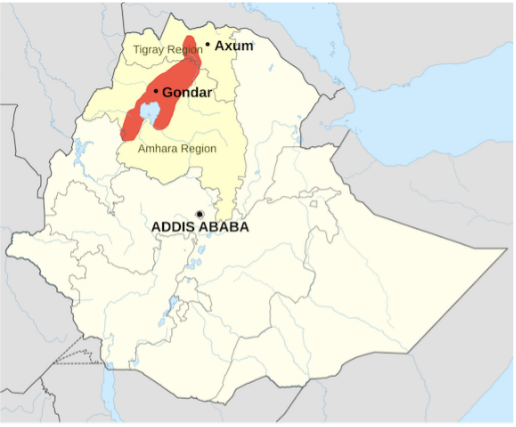
For nearly two millennia, they have preserved a fierce, independent Jewish identity in the rugged mountains of northern Ethiopia, northeast of Gondar. Some trace their origins to the tribe of Dan, one of the ten lost tribes of Israel.
Others tell of nobles who accompanied Menelik, the son of King Solomon and the Queen of Sheba, from Jerusalem to Africa.
Whatever the precise path, their practice preserves a strikingly ancient form of Judaism. Their scripture is the Orit, the Torah rendered in the classical Ge’ez language. Their spiritual leaders are not rabbis but Kessim, a hereditary priesthood that guarded the faith through centuries of complete isolation from the rest of the Jewish world.
Political takeovers and conflicts eventually led to disastrous years: many were stripped of the right to own land, pushed into trades like blacksmithing and pottery, and branded with the name “Falasha,” meaning stranger or landless one.
They call themselves Beta Israel: The House of Israel.
The Ethiopian Jews kept the Sabbath with great strictness and observed the biblical laws of purity.
Passover was the most meaningful of the Holy Days because just like the slaves of Egypt waiting for deliverance, so were they waiting to be delivered and go to Israel.
They observed much of Jewish tradition familiar to all, but also practices from the Torah which, since the destruction of the Temple, are no longer observed by the rest of the Jewish world. They did not realise that the Temple had been destroyed in 70 AD and many older men on arriving in Israel had asked to be taken there. The grief of learning of its non existence added to the shock of arrival in a country so different from their perceptions.
Their deep longing to go to Jerusalem was reflected in their prayers, songs and in a unique ceremony found nowhere else in Judaism, called Sigd. Sigd, held fifty days after Yom Kippur, when the whole community would climb a mountain to fast, read from the Orit, and renew the covenant, whilst facing Jerusalem.
So central is this observance that in 2008 the State of Israel declared Sigd an official national holiday. “When we were still in Ethiopia we fasted in the mornings for fifty days after Yom Kippur, the Day of Atonement”, explained Ma´ayan, one of the Ethiopian Jewish students at Ruppin. “Then we went up on a high mountain with our leaders to pray in the hope that we will soon be able to go to Israel. Afterwards there was a festive meal with music and dance that we called the Sigd festival. Now that we are in Israel, we have wanted to keep this tradition to thank God that He brought us to the Promised Land.”
Despite the longing of Beta Israel to go to the Holy City of Jerusalem, for most of history, the Jewish world barely knew they existed. That changed in modern times when travellers reported on their existence, but especially 1973, when Rabbi Ovadia Yosef, the Sephardic Chief Rabbi of Israel, ruled that the Beta Israel were descendants of the tribe of Dan and fully Jewish under religious law. In 1975, the Israeli government formally recognized their right to citizenship under the Law of Return.
A door that had been closed for two thousand years began to open.
The first major group of Ethiopians Jews – numbering nearly 12,000 – set off for Israel in 1983-1984, with only 8,000 completing the journey alive. The perils they faced were too numerous and horrific to recall. Hunger, thirst, attacks by bandits and wild animals, living in refugee camps with rampant disease and malnutrition – these were the dangers every family had to face each day on the exhausting, three-month march to Israel. Many fell along the way.
“I was eight years old when I started my journey from Ethiopia to Israel via Sudan”, recalled Erez Dezlin. “My little brother was two years old and my mother was also six months pregnant. We walked about 600 miles on foot. We did not have much food with us to eat. Many families lost loved ones on the way, some died from hunger, thirst, diseases and some even were killed by robbers on the way. During our waiting time in the Sudanese camps for the Israeli air planes to come pick us up, I had to work in one of the nearby villages so we would have something to eat. Almost every day I was beaten up by the people there, until one time I hit one of them back with a stone on his head and then I had to spend a week in prison. I am so glad that I finally made it and my dream to live in Israel became real.”
The Rescues Begin:
In 1984, after Israeli Prime Minister Menachem Begin told the head of the Mossad: “Bring me our Ethiopian brothers”, a secret Israeli airlift of Ethiopian Jews named Operation Moses brought thousands of Ethiopian Jews who had set out to Israel by foot.
In late May 1991, another dramatic rescue called Operation Solomon which involved 34 round-trip flights in 36 hours, brought nearly 15,000 Ethiopian Jews to Israel. At that time, rebels opposed to the Marxist regime in Addis Ababa were closing in on the capital, forcing the country’s military ruler to flee. With diplomatic intervention from the United States, Israeli leaders convinced the rebels to allow them to bring the throngs of Jews home in a swift, massive operation over one weekend.
The Problems of Integration
- Learning Hebrew is a huge challenge as some are not even literate in their native Amharic language.
- Making the transition from an agrarian, traditional patriarchal society of Ethiopia to the modern, technical world of Israel is an enormous leap and they come without skills suited for a modern society. Traditional gender roles have been upended and often it’s the children who, because of picking up Hebrew more quickly, have to undertake some everyday roles rather that the parents, leading to disorientation and family conflict.
- Many Ethiopian children begin school with a significant disadvantage as their parents, often illiterate or with limited Hebrew, are unable to provide academic support.
- Also, unfortunately, Ethiopian Israelis often feel unaccepted as fully Israeli because of their skin colour.
ICEJ and the Ancient Ethiopian Jewish Community
The ICEJ has been assisting with the aliya of Ethiopian Jews ever since the 1991 emergency airlift Operation Solomon.
Among the daunting challenges that Israel’s government faced in absorbing them into a modern culture, was that many of the Ethiopian immigrants had urgent medical problems including leprosy, but Israel had no doctors able to speak their native Amharic language.
Israel’s Foreign Ministry asked if the International Christian Embassy Jerusalem could locate a doctor who spoke Amharic to treat these new immigrants. Dr. Campbell Millar and his wife Ferne had served for many years on a medical mission in Ethiopia, and they agreed to come on staff to treat Ethiopian patients. Around the same time, the Finnish Parliament donated a mobile medical clinic to the ICEJ, which was used for the next decade to treat Ethiopian Jews, as well as many Bedouin communities in the Negev.
A retired Australian Surgeon, Dr. Grace Warren, who had been involved in missionary medical work particularly with leprosy patients, made regular trips to Israel to assist Dr Campbell with her expertise.
Other and ongoing Projects
ICEJ has over the years sponsored camps or sport and other initiatives for Ethiopian youth to more easily integrate into Israeli society.
Assistance given to help with the Ethiopian absorption process, included household items, medical aid and job searches. ICEJ also sponsored the building of two tukuls (traditional Ethiopian meeting places) in the town of Beit Shean.
ICEJ AID has provided special educational opportunities and after-school programs for Ethiopian youths at-risk. Some 70% of Ethiopian Jews in Israel still live below the poverty line, and many teenagers are at risk of dropping out of high school and ending up in detention centres.
ICEJ also is sponsoring scholarships for promising Ethiopian students to earn university degrees and receive special vocational training at the Ruppin Academic Center near Netanya, thereby equipping the future leaders of this distinctive community.
In recent years it was recognised that the trauma of their long and difficult journey had remained hidden and the painful memories of those arduous times had not been addressed. Therefore, the ICEJ has helped to fund a special project at the Israel Centre for Psycho-trauma which seeks to lift many disadvantaged Ethiopian immigrants out of a cycle of poverty and failure, largely caused by trauma. With our help, the centre is providing individual psycho-traumatic treatments for these Ethiopian olim.
ICEJ also supports mentoring projects that are vital for “acquaintance through stories,” connecting established Israelis with new immigrants to help them navigate the complexities of life in Israel—from language and banking to finding a job and a home.
‘Ethiopian Immigrant Integration Strategies Within Israel’s Modern-Day Restoration.’
This title is the name of the thesis undertaken by Nicole Y. Yoder, ICEJ’s Vice President for Aid and Aliyah. Her work offers a comprehensive look at the challenges, emphasizing that successful integration is a two-way street requiring effort from both the immigrants and the host society. In her thesis, Nicole explores the complex story of the Beta Israel, from their inspiring aliyah journeys to their current struggles and future hopes.
Nicole’s thesis concludes with a message of hope, echoing the sentiments of Shmuel Yilma, a former child refugee who has become a community leader. For him, his traumatic journey “is still an inner inspiration and strength… and gives [me] the vision going forward”.
Like Shmuel, and like the students we support, the Ethiopian community is not defined by its struggles but by its faith, determination, and the dream of a better future in the land of their ancestors. It is our privilege at the ICEJ to walk with them on this path.
Ongoing Aliyah
The situation for Ethiopian Jews still living in the war torn Amhara and Tigray regions of northern Ethiopia remains a humanitarian emergency. By 2026 an estimated 7,000 to 12,000 people still remain and face extreme poverty, hunger, and the looming threat of violence.
The longer story of Ethiopian Aliyah is a hope for their future generations. The children of earlier waves now serve as officers in the Israel Defence Forces, work as physicians and nurses in Israeli hospitals, sit in the Knesset, and win international medals for Israel in athletics.
ICEJ is committed to bringing home more of this ancient branch of Israel’s family and especially the Falash Mura. These are Jews whose ancestors were pressured to convert to Christianity about 150 years ago for economic reasons but still sought to retain in part their Jewish identities and traditions. The Israeli Government was reluctant to agree to their return in the beginning but has gradually permitted their flights.
Since 2015 alone, ICEJ has sponsored flights for over 3,286 Ethiopian Jewish immigrants and will continue to acknowledge the banner that God raised for the nations:
“See, I will beckon to the nations, I will lift up my banner to the peoples; they will bring your sons in their arms and carry your daughters on their hips”.
(Isaiah 49:22)
Let us celebrate those who just arrived and work and pray for those still waiting in very difficult conditions who need our urgent help. Join us in funding more Aliyah flights of Ethiopian Jews and in supporting their absorption in Israel.